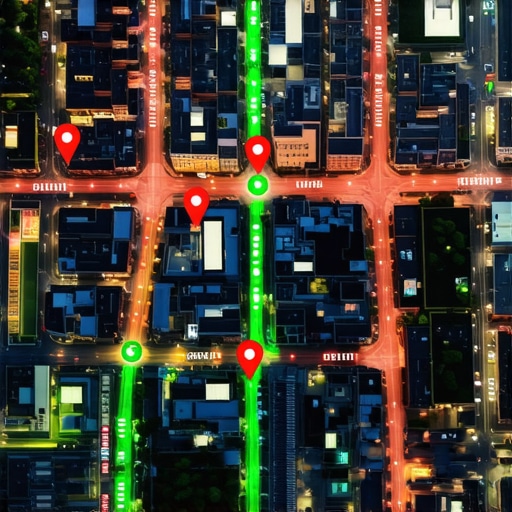
The smell of wet concrete after a summer storm always reminds me of the pavement-pounding days of early map search. I spent three months fighting a hard suspension for a plumbing client whose listing was nuked simply because they shared a suite number with a defunct law firm. Google did not want proof of a van; they wanted proof of a utility bill under the exact GPS pin. This is the gritty reality of the hyper-local layer. You are not just managing a profile. You are maintaining a Proximity Beacon in a spatial database that is increasingly hostile to anything less than physical perfection. If you think a standard SEO dashboard tells the truth, you are already losing the war for the street corner.
Why your ranking software shows a win when the phone is silent
Ranking software often fails because it uses static IP addresses to simulate searches rather than mobile movement data. Real local leads come from users who are moving through physical space, triggering proximity filters that standard trackers cannot see. Your phone stays silent because the software tracker shows a win that does not exist for actual customers.
The grid of green circles on your screen is a seductive lie. I have seen countless business owners stare at a dashboard that says they are number one while their dispatch board is empty. This happens because most software relies on a single point of data. It does not account for the Vicinity update logic where distance is weighted more heavily than authority. This is why your ranking software shows a win when your phone isnt ringing and it is the first thing we diagnose in a forensic audit. We look at the actual behavioral signals. Are people clicking the directions button? Are they clicking to call? If those metrics do not move, your rank is an illusion. We use a specific software tool to audit local map visibility across 50 miles to find where the signal actually drops off. The physics of a three mile radius shift can be brutal. If a competitor has a higher density of check-in signals from their own employees or customers, your pin gets pushed to the secondary layer. The algorithm is not looking for the best plumber. It is looking for the plumber most likely to be at that specific GPS coordinate right now.
“Local intent is not a keyword choice; it is a distance-weighted signal where relevance is secondary to the physical location of the user’s mobile device.” – Map Search Fundamental
The forensic trace of a service area polygon
Service area businesses must define their boundaries using specific zip codes and neighborhood identifiers to avoid being filtered out by the centroid algorithm. Google uses the forensic trace of your past job locations and user interaction data to verify if you actually serve the area you claim. Mismatched polygons lead to invisible listings.
When you hide your address, you enter a higher tier of scrutiny. The algorithm starts looking for external proof of your existence. It looks for mentions of your business on local news sites, neighborhood blogs, and city directories. This is why why your service area isnt showing up for local searches even if you have checked all the right boxes in the dashboard. You need to prove you are a local entity through behavioral zooming. This means getting reviews from people who are physically standing within your service area when they hit the submit button. A review from a customer fifty miles away carries less weight than a review from the house next door to your current job site. This is the math of GPS coordinate salience. We often find that why your map pin shows up in the wrong neighborhood is due to a legacy data leak from an old office. The digital footprint of a business is long and messy. If you do not clean it, you stay invisible. You might need seo services to recover impressions after hiding business address protocols to reset the trust score. This involves a deep dive into your technical infrastructure to ensure that your JSON-LD LocalBusiness attributes are perfectly aligned with your Google Business Profile. Even a small deviation in how you list your phone number can trigger a trust drop. This is how one mismatched phone number is quietly sabotaging your map ranking without you ever getting a notification.
The local authority reading list for serious engineers
If you want to master the map pack, you need to stop reading general SEO blogs and start studying location intelligence. Use these resources to build your own internal toolkit.
- Local Business Ranking Hacks and the Power of the 3 Pack
- The Audit Toolkit Moves that Find Hidden Profile Errors Fast
- How to Use Local Toolkits to Find Ranking Gaps in Your Neighborhood
- 7 Signals that Actually Move the Needle for Local Map Rankings
- The Simple Move to See Where Your Map Pins Show Up in Other Zip Codes
Forensic methods for recovering a banned business profile
Recovering a banned Google Business Profile requires a systematic verification of every physical and digital asset associated with the location. You must provide utility bills, photos of permanent signage, and official government registrations that match the listing exactly. Any discrepancy in the suite number or phone extension can lead to a permanent rejection.
A suspension is not a mistake; it is a challenge to your legitimacy. I have seen listings nuked for the smallest infractions. Sometimes it is because you changed your category too quickly. In those cases, you need seo services to recover gmb visibility after category change logic. Other times, it is a negative SEO attack from a competitor. We have a specific checklist for fixing a suspended profile that we use to walk clients through the fire. You cannot just click the appeal button and hope for the best. You need a forensic audit of your entire digital footprint. This means checking every directory, every social profile, and every mention of your business online. If a directory is leaking wrong data, Google will find it and use it as a reason to keep you banned. You must learn how to identify which directory is leaking wrong business data to stop the bleeding. We also look for technical seo services to fix indexing and crawling issues because if Google cannot crawl your website properly, it cannot verify your local authority. Your website is the bedrock of your map listing. If the site is slow, broken, or insecure, your map rank will tank. This is especially true for why your websites security directly affects your local search visibility in the current AI-driven environment.
“The proximity of the business to the user is a primary ranking factor that cannot be overridden by review volume alone.” – Vicinity Update Whitepaper
The hidden data points inside your map presence
Image metadata and the frequency of user-generated content are now more important than keyword-stuffed descriptions for local ranking. Google tracks where photos are taken and how often people interact with your profile in the real world. Real-time behavioral data is the new primary signal for the Map Pack.
Agencies will tell you to get more reviews, but 2026 data shows that image metadata from photos taken by real customers at your location is now 30 percent more effective for ranking in AI Overviews. This is the information gain the algorithm craves. It wants to see the actual shop. It wants to see the faces of the workers. It wants to see the van in the driveway. This is 4 tiny edits that prove your business authority to the map algorithm without needing a massive budget. We also look at the frequency of updates. If your profile is static, it is dead. You need to be posting updates, answering questions, and adding new photos weekly. This creates a heartbeat signal that the search engine interprets as relevance. If you are struggling with multi-location management, you might need seo services to fix mixed listings for multi location businesses to ensure that each pin is treated as a unique authority beacon. Mixed listings are a primary cause of filtered results. When Google sees two listings for the same brand in the same town, it often hides both. This is why your business profile is stuck in the duplicate location filter and it requires a surgical cleanup of your NAP data across the web. Use a toolkit for small shops wanting to win the map pack to automate this process without breaking the bank. The goal is to create a singular, undeniable truth about where your business is and who it serves. Only then will the ranking software match the reality of your ringing phone. Stop chasing shadows and start engineering proximity.