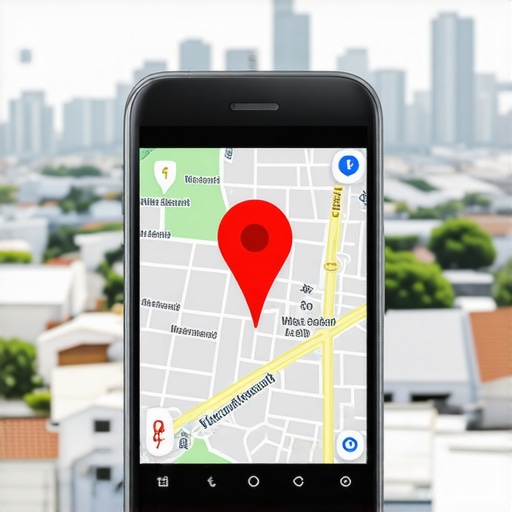
I smell peppermint and old paper as I look at another case of map displacement. It feels like an old detective story where the body was found in one zip code but the crime happened in another. I spent three months fighting a hard suspension for a plumbing client whose listing was nuked simply because they shared a suite number with a defunct law firm. Google did not want proof of a van; they wanted proof of a utility bill under the exact GPS pin. The algorithm does not care if you have been in business for fifty years. If the spatial math fails to resolve, your business becomes a ghost. This is the reality of the hyper-local layer. You are not just a business name. You are a set of coordinates in a massive spatial database that demands absolute verification. When your pin moves, your revenue vanishes. Most people think it is a simple glitch. It is not. It is a proximity filter deciding you do not belong where you say you are.
The ghost in the GPS coordinates
Google Business Profiles rely on precise geocoding and spatial clustering to determine where a physical storefront exists in the local map pack. This displacement often happens because of mismatched NAP data or conflicting category signals that confuse the vicinity algorithm. Map pins drift when third party directories provide corrupted address strings to the primary data cluster. If your coordinates are even slightly off, you will find the exact reason your business profile stopped showing up in local searches is often a hidden technical conflict. The pin moved. Now customers are driving to a vacant lot three blocks away. This is the death of local trust. I have seen listings drop five miles simply because of a change in office hours that triggered a re-verification loop. You must understand why your map listing disappeared after you changed your office hours to prevent this spatial drift. It is not about the hours. It is about the trust score attached to the coordinate stability.
[image_placeholder]
Why your physical address is a liability
Physical proximity remains the strongest ranking signal in the Google local ecosystem, often outweighing domain authority or review count. When a business uses a shared office space or a virtual address, the spam filter targets the GPS centroid of that building, often hiding all profiles except the most prominent entity. This is where the address mismatch error killing your local phone calls begins to drain your marketing budget. The algorithm sees five businesses in one suite and decides four of them are fake. This is the spatial logic of a dispatch system. It wants the user to have the shortest path to the most legitimate service. If you are a lawyer in a tower with twenty other firms, you are fighting for a single pixel of space. You need to know why your law firm stays invisible in local search while competitors take the calls even if you have more reviews. It is the math of the 3-pack. It is the physics of the map.
“Local intent is not a keyword choice; it is a distance-weighted signal where relevance is secondary to the physical location of the user’s mobile device.” – Map Search Fundamental
The three mile radius that determines your revenue
Search proximity filters create a mathematical boundary around a user’s mobile device, heavily favoring businesses within a three mile radius. As the user moves, the map pack results shift dynamically, meaning ranking software often provides a false sense of security by only tracking the centroid of a zip code. This is why the recovery plan for businesses suffering from proximity based drops focuses on hyper-local relevance rather than national backlink building. I have watched plumbers lose leads because they were on the wrong side of a bridge. The algorithm saw the bridge as a psychological barrier. It preferred a closer, less-rated shop. This is why the real reason youre losing leads to a shop three miles further away is usually spatial salience. Google wants to provide the path of least resistance. If your pin is displaced, you are already outside the circle of trust.
Local SEO software to improve map pack rankings
Advanced local audit tools must analyze JSON-LD coordinates and API response data to find ranking gaps that standard trackers miss. Relying on a single rank tracker is a mistake because proximity signals are too granular for simulated searches from a single IP address. You need the toolkit we use to audit google business profiles in minutes to see the real data. Many tools show you at the top because they search from a fixed point. Your customers are moving. They are in cars. They are walking. This is why your ranking software shows a win when your phone isnt ringing lately. You are winning a race that no one is watching. The software is giving you ghost positions. You need to use 5 local seo tools that find hidden ranking gaps to uncover the spatial truth of your local presence. Stop trusting the dashboard. Trust the phone line.
Local Authority Reading List
- A lean toolkit for small shops wanting to win the map pack
- 7 signals that actually move the needle for local map rankings
- Why your google profile description isnt actually helping you rank
- The audit checklist for businesses stuck outside the 3 pack
- Why your local ranking dropped overnight and how to get it back
Tactical forensic audits for banned listings
Google Business Profile suspensions often stem from address verification failures where the physical storefront cannot be visually confirmed by street view data or utility documentation. When a listing is banned, the recovery process requires a forensic audit of every digital footprint left by the business over the last decade. This is why the exact steps we take to fix a suspended business profile fast involve more than just filing a form. You have to prove you exist in physical space. If you used a shady lead provider in the past, your address history is tainted. You must learn how to clean your digital footprint after using a shady lead provider before the reinstatement team will even look at your case. Google hates spammy backlinks. They hate duplicate profiles. If you are stuck in the duplicate location filter, you are invisible. We have to clear the metadata errors. We have to unify the NAP data across every fragmented directory.
“Relevance is no longer just about the words on a page but the historical stability of the location data provided to the index.” – Local Search Intelligence Report
The slow death of a storefront by technical decay
Slow website speeds and unresolved technical errors directly impact local map rankings by reducing the trust score Google assigns to the associated business profile. A pest control company might have the best reviews in town, but if their site is slow or infected with malware, the map pin will start to rank lower or disappear entirely. This is how we found the signal block preventing your pest control site from ranking for our last client. It was not the SEO. It was a malicious script slowing down the mobile experience. You need seo services to fix slow website and technical issues because Google Maps is a mobile-first product. If the user cannot load your contact page in two seconds, Google will not show your pin. It is that simple. Security matters. Speed matters. Metadata hidden in your storefront photos matters more than the description text you spent hours writing.
The forensic trace of a service area polygon
Service Area Businesses must define their operational boundaries using specific zip codes rather than a vague radius to avoid proximity penalties triggered by overlapping service polygons. If you try to cover too much ground, you end up ranking for nothing. This is why your service area pages fail to reach the next town over most of the time. You are spreading your local authority too thin. The algorithm wants to see density. It wants to see reviews from people actually in those neighborhoods. Check-in signals are the new backlinks. If your workers are not using local seo checklist and toolkit for gmb to document their presence in the field, you are missing 30 percent of your ranking potential. Image metadata from photos taken at the job site is now more effective than bulk reviews. Stop asking for five stars and start taking photos. The GPS coordinates inside those image files prove you were there. That is the signal the map pack craves in 2025 and 2026.