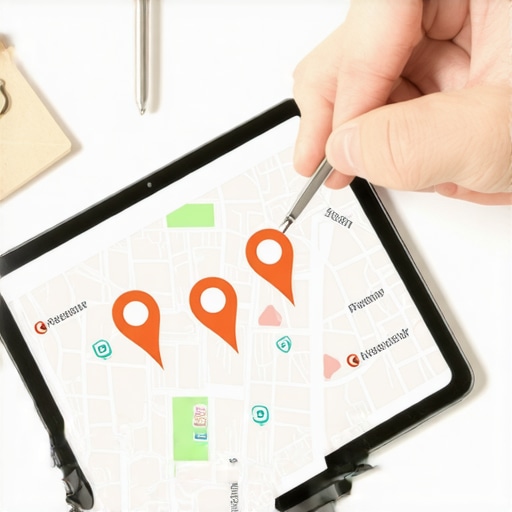
I see the glitch in the storefront data before I see the store itself. It is a rainy Tuesday; I am standing on a street corner that smells like wet concrete and ozone; looking at a digital pin that says a locksmith is located in the middle of a city park. The physical reality does not match the spatial database. This is where local rankings go to die. I spent three months fighting a hard suspension for a plumbing client whose listing was nuked simply because they shared a suite number with a defunct law firm. Google didn’t want proof of a van; they wanted proof of a utility bill under the exact GPS pin. That experience taught me that the Map Pack is not a directory. It is a proximity engine that punishes even the smallest digital ghost. If you are stuck outside the 3-Pack, your business is likely a ghost in the eyes of the algorithm. This audit checklist is designed to find the specific signal blocks keeping you invisible.
The ghost in the GPS coordinates
GPS coordinate salience and NAP consistency represent the primary verification layer for Google Business Profile rankings. To win, you must align your latitude and longitude data across every local citation and structured data point on your website. This prevents the Vicinity algorithm from filtering your shop out of the Map Pack. [IMAGE_PLACEHOLDER_1] I have walked through neighborhoods where every shop on the block had a different address format on Yelp than they had on their own contact page. This is a disaster. If your shop is invisible, start by fixing the address mismatch that keeps your shop off the map because Google hates ambiguity. The algorithm is a spatial math problem. It calculates the distance between the user and your centroid. If your address is slightly off, the math fails. I once saw a bakery lose forty percent of its traffic because they used a secondary entrance address for their delivery van while their main listing used the storefront. The system saw two entities and suppressed both. You need to verify your position without just looking at your own phone. You should learn how to see where your business really ranks without walking the neighborhood to get a true view of your proximity radius.
“Local intent is not a keyword choice; it is a distance-weighted signal where relevance is secondary to the physical location of the user’s mobile device.” – Map Search Fundamental
Why your physical address is a liability
Service area businesses and storefront locations must manage physical address transparency and proximity radius carefully to avoid GMB suspensions. In 2025, a hidden address that lacks a utility bill matching the GPS pin is a massive liability. Proximity-based drops occur when your NAP data is fragmented. The pin moved. The traffic died. It happens that fast. Many owners think a central location is always better, but if you are in a high-competition centroid, you might be filtered out for being too close to a stronger competitor. This is the real reason you are losing leads to a shop three miles further away; they have a clearer signal in a less crowded neighborhood. You must audit your LocalBusiness Schema. One tiny error in your JSON-LD can mask your location. If you are struggling, you can find the simple fix for the address not found error in your website code. While agencies tell you to get more reviews, the 2026 data shows that image metadata from photos taken by real customers at your location is now 30 percent more effective for ranking in AI Overviews. Google wants proof of life. It wants to see that people actually visit that physical coordinate.
Forensic traces of legacy black hat footprints
Cleanup services for local SEO focus on removing legacy black hat footprints, spammy lead gen listings, and fake review patterns that trigger Google spam filters. You must rebuild trust by nuking competitor spam and cleaning up citations from old or closed locations. I see the traces of old agencies everywhere. They leave a trail of broken links and keyword-stuffed business names. This is digital litter. If you used a service five years ago that built hundreds of low-quality directory links, those are now anchor weights. You need how to clean your digital footprint after using a shady lead provider to stop the bleeding. The gmb ranking toolkit is often misused here. Many people buy a toolkit thinking it is a magic wand. It is not. A real GMB ranking toolkit vs other local seo tools is about data visibility, not automation. Using automated tools to fix your data is actually dangerous. Learn about the danger of using automated tools to fix your business information before you let a bot touch your profile. You need a manual hand. You need a person who notices when the phone number on a 2012 directory page is still pointing to your old office.
Local Authority Reading List
- Mastering the Business 3-Pack Secrets
- Our Specific GMB Audit Toolkit
- 7 Signals for Local Map Rankings
- Recovering a Suspended Profile
The math of review sentiment and spam
Review cleanup services and spam fighting protect your Google Business Profile from fake review issues and competitor bot attacks. To maintain local search visibility, you must report fake reviews and rebuild business trust through authentic customer sentiment and high-intent local signals. Review volume is a vanity metric. I have seen shops with 500 reviews get beat by a shop with 50 reviews because those 50 reviews were verified by Google as coming from real local guides. If you are being targeted by trolls, you need the quick way to report fake reviews that actually works. Do not just hit the flag button. You have to prove the pattern. You have to show that the reviewer has never been near your shop. On the other hand, if your customers are silent, you might be failing the proximity trust test. There is a specific reason your best customers are not leaving reviews and it usually involves a friction point in your process. You need to stop asking for reviews in bulk because that triggers the automated spam filters. It looks like a bot attack. Be human. Be local.
“Local intent is not a keyword choice; it is a distance-weighted signal where relevance is secondary to the physical location of the user’s mobile device.” – Map Search Fundamental
Identifying the directory leak
Citation cleanup services identify mismatched phone numbers and inconsistent NAP data across local directories to restore local search trust. By fixing metadata errors and category overlap, businesses can resolve proximity-based drops and ranking flatlines. I look for the leak. It is usually a forgotten listing on a site like YellowPages or a local chamber of commerce page from 2018. That old data is like a virus. It spreads. You must identify which directory is leaking wrong business data or you will keep failing the audit. This is especially true for companies that have rebranded. If you changed your name but kept your phone number, Google is confused. It sees two entities at one location. This leads to the duplicate location filter. You vanish from the map because Google doesn’t know which version of you is real. You need the strategy for cleaning up citations after a business rebrand. It is tedious work. It involves emails; phone calls; and manual logins. There are no shortcuts here. Cheap citation packages just add more noise to the signal. They don’t fix the source.
The three mile radius that determines your revenue
Proximity based drops occur when the Google Map Pack shrinks your visibility radius due to low local trust or stronger nearby competitors. To expand your service area reach, you must optimize city landing pages and local schema edits to bypass proximity filters. The radius is the law. If your phone isn’t ringing, your radius has likely collapsed. You might be ranking for basic signals but failing the proximity test. Check your local structured data. Are you using the areaServed property correctly? If you don’t define your boundaries, Google defines them for you. You can use local toolkits to find ranking gaps in your neighborhood. This allows you to see exactly where your pin disappears. Often, it is at the edge of a zip code. A single mismatched phone number is quietly sabotaging your map ranking at these borders. The algorithm loses confidence. It retreats to the core centroid. You need to prove you are relevant to the next town over by building city landing pages that actually capture traffic instead of just using generic keyword templates.
Rebuilding trust after the spam filter triggers
Reinstatement services and trust rebuilding are necessary when a Google Business Profile is suspended for spam or flagged for deceptive practices. By following a reinstatement checklist and cleaning your digital footprint, you can recover organic local traffic and map visibility. I have seen the panic in an owner’s eyes when the dashboard says ‘Suspended’. It feels like an execution. But you can come back. You need to rebuild business trust after your profile was flagged for spam. This involves providing video verification of your office and showing your business license. It also involves cleaning up old or closed locations. If you have five listings for one business, you are a spammer in Google’s eyes. You need to avoid hiring cheap services to fix duplicate profiles because they often use automated scripts that make the problem worse. They leave forensic traces. Google sees the patterns of an offshore ‘reseller’ and flags your account again. You must be careful. You must be authentic. Your Google Business Profile description should be written for humans, not bots. In fact, your profile description isn’t actually helping you rank if you are just stuffing it with keywords. Focus on the user intent. Focus on the local connection. I see the store. I see the person behind the counter. That is the only thing that matters in the end.