How We Found the Exact Keywords Local Competitors Use to Steal Map Leads
It is the ultimate frustration in local business: you have more reviews, a better-looking website, and a superior service, yet your competitor is sitting comfortably at the top of the Google Map Pack. You look at their profile and see a sparse description and generic photos, yet they are vacuuming up the phone calls that should be yours. This isn’t an accident; it is “Map Lead Theft.” Competitors are increasingly using “ghost” keywords and hidden category configurations to capture local intent that you didn’t even know existed.
My name is Marco Herrera, and I’ve spent years deconstructing the mechanics of the local algorithm. What we’ve discovered is that the battle for the 3-pack is no longer about who has the most stars – it’s about who has the most precise data signals. Today, the landscape is more competitive than ever. Recent data shows that over 26,000 businesses are now leveraging advanced automation and google business profile seo to manage their profiles, leaving those who rely on “set it and forget it” strategies in the dust. If you want to reclaim your leads, you have to stop guessing and start reverse-engineering the exact keywords your competitors are using to hide in plain sight.
The “Hidden Category” Heist: Finding Your Competitor’s Secret Sauce
Most business owners believe that the category they choose in their Google Business Profile (GBP) dashboard is the only one that matters. They pick “Plumber” or “Lawyer” and call it a day. However, the primary category is just the tip of the iceberg. The real “heist” happens in the secondary categories – the ones that don’t always appear on the front-end of a Google Maps listing but heavily influence which searches trigger that business.
To find these hidden triggers, we use the “View Page Source” method. This is a technical deep dive that reveals the “gcid” (Google Category ID) strings associated with a competitor’s listing. Here is how you can do it right now:
- Open Google Maps and search for your top competitor.
- Click on their business listing to open the full profile.
- Right-click anywhere on the profile and select “View Page Source.”
- Press Ctrl+F (or Cmd+F on Mac) and search for the term “gcid”.
What you will find is a list of categories that Google has associated with that business. Often, a competitor ranking for “emergency plumber” while you only rank for “plumber” has specifically added “Emergency Service” or “Repair Service” as a secondary category. These act as the exact keywords that bridge the gap between a general search and a high-intent, high-conversion search. If you aren’t optimized for these niche categories, you are essentially invisible for the most profitable leads. This is a common Category Selection Error That Makes Your Business Invisible to Local Searchers, and fixing it is the first step in your recovery plan.
By identifying these GCIDs, you can align your profile with the specific intent Google is already rewarding. Don’t just copy them blindly; analyze which ones correlate with the highest-value services you offer. This level of local seo tools integration allows you to speak the language of the algorithm directly.
Geo-Grid Analysis: Why Your Rank Tracker is Lying to You
If you are using a standard rank tracker that tells you “You are #1 for [Keyword],” you are likely falling victim to the “Proximity Error.” The reality of 2025 and 2026 local search is that rankings are hyper-local – down to the street corner. A business might rank #1 when searched from its own front door but drop to #15 just two blocks away. This is where competitors “steal” leads: they optimize for the micro-locations where you are weak.
Our research into “ghost positions” shows that many businesses suffer from signal drop-off because they haven’t optimized for the specific geographic “nodes” surrounding their physical location. As we move into 2026, the introduction of the “LiDAR Patch” and more sophisticated “Sensor Signals” means Google is using mobile device data and visual mapping to determine exactly how “present” a business is in a neighborhood. If your competitor has more “check-ins” or photo uploads from a specific suburb, they will dominate that micro-grid even if you are closer to the city center.
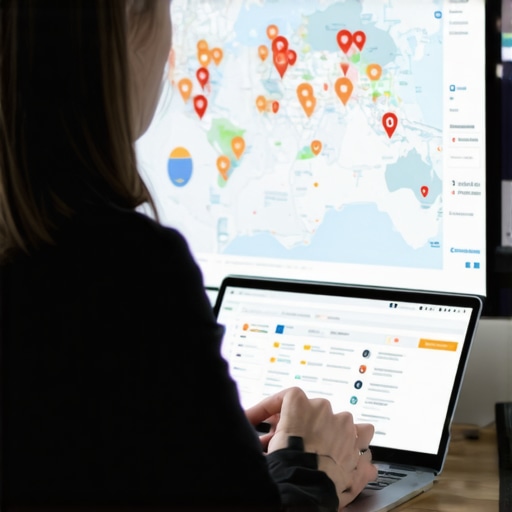
To fight back, you need a 13×13 Geo-Grid analysis. This provides a visual map of your rankings across a several-mile radius. Where you see “red” (low ranking), your competitor is likely using localized content or geo-tagged assets to claim that territory. Using professional local seo ranking tools is the only way to see the truth. You might discover Why Your Map Tracker Shows You at the Top While Customers Can’t Find You, allowing you to pivot your strategy toward the areas where the leads are actually being lost.
Competitors often “teleport” their relevance by ensuring their website mentions specific landmarks, neighborhoods, and intersections within these micro-grids. This creates a “Signal Block” that tells Google their business is the most relevant result for a user standing in that specific spot.
Reverse-Engineering the “Service Area” Strategy
For Service Area Businesses (SABs), the theft of leads is even more aggressive. Since there is no physical storefront to pin to the map, Google relies heavily on the “Signal Blocks” mentioned earlier. We have found that top-ranking competitors are using a sophisticated combination of SAB settings and city-specific landing pages to expand their reach far beyond their actual base of operations.
When we reverse-engineer these strategies, we often find that the competitor’s website structure is feeding Google significantly more local relevance than a standard “About Us” page. They aren’t just saying they serve a city; they are proving it through localized schema markup and service-specific pages for every zip code. This is a critical component of google business profile optimization. If your site doesn’t have a clear hierarchy that connects your GBP to specific service areas, Google will default to the competitor who does.
Many owners wonder Why Your Service Area Pages Fail to Reach the Next Town Over. The answer usually lies in the lack of “entity connection.” Google needs to see that your business entity is physically or service-logically connected to that location. Competitors “steal” these leads by embedding Google Maps of their service routes or featuring reviews from customers in those specific outlying towns. This creates a high-trust signal that the algorithm cannot ignore.
The 2026 Trust Filter: Beyond Reviews and Citations
The old playbook of “more citations and more reviews” is dying. In the 2026 local SEO landscape, Google has implemented what we call the “Trust Filter.” This filter looks beyond the NAP (Name, Address, Phone) and examines “Core Speed” signals, IoT data, and even AI Overviews (SGE) to determine who deserves the 3-pack.
Competitors are now using “Visual Search Tactics” to secure their positions. This involves uploading high-resolution, metadata-rich photos that Google’s AI can “read” to confirm the business offers the services it claims. For example, if a competitor ranks for “kitchen remodeling,” their profile is likely filled with photos that Google’s Vision AI identifies as “modern kitchens,” “shaker cabinets,” and “granite countertops.” These are “Visual Brand Fixes” that act as non-textual keywords.
Furthermore, the “IoT Data Fix” involves how your business interacts with real-world signals. Are people actually visiting? Is your “Popular Times” data accurate? Google is increasingly filtering out businesses that have high rankings but low real-world engagement. If you want to stay relevant, you must understand the Surviving the 2026 Google Maps SEO Update: 4 Signals That Still Matter. One of the most effective ways to bypass the filter is by using a professional google maps ranking service that focuses on these advanced trust signals rather than just basic backlinks.
We are also seeing the rise of “AR Overlay Fixes.” As users increasingly use augmented reality to find businesses through their phone cameras, your GBP needs to be optimized for visual recognition. This means your physical signage and storefront (as captured in Street View and user photos) must match your digital identity perfectly to maintain a high “Trust Score.”
Your 5-Step Action Plan to Reclaim the Map Pack
Knowing how the theft happens is only half the battle. You must take proactive steps to push the “thieves” out of your territory. Here is the framework we use for our clients to achieve Map Pack Entry Strategies: Achieve Top Status in Google Maps Today:
- Audit Hidden Categories: Use the “View Source” method to find the GCIDs of the top 3 competitors. Update your profile to include any relevant secondary categories you’ve missed.
- Run a 13×13 Geo-Grid: Identify the specific neighborhoods where your ranking drops. This is where you need to focus your local content and photo updates.
- Fix “Signal Errors” in the Description: Ensure your GBP description isn’t just a sales pitch. It should contain “Entity Keywords” – the landmarks, services, and neighborhood names that define your local area. You can learn How to Rank My Business Maps Effectively: Expert Tips for 2025 to refine this further.
- Update Photos with “Visual Brand Fixes”: Upload at least 5 new photos a week. Ensure they are taken at your place of business or in your service area with location services turned on.
- Automate Review Responses: Use SEO Viper Tools to automate responses that naturally include your primary and secondary keywords. This keeps your profile active and signal-rich.
Remember, consistency is the enemy of your competition. Most businesses will do this once and stop. By making this a part of your weekly routine, you create a “moat” around your rankings. If you’ve ever wondered about Business 3 Pack Secrets: How to Dominate Local Rankings Now, this is the blueprint.
Be careful during this process, however. We have seen The exact reason your mappack entry disappeared after a simple name change – Google is highly sensitive to major edits. Always make changes incrementally to avoid triggering a suspension.
Conclusion: Stop Being the Best-Kept Secret in Your City
The leads are there, and the customers are searching. If you aren’t in the Map Pack, you are effectively invisible to the 80% of local searchers who never click past the first three results. Stop letting your competitors use technical loopholes and hidden categories to steal your revenue.
It is time to move beyond “cheap citation services” that provide no real value. To win in 2026, you need sophisticated local seo software that gives you the same “insider” data the pros use. Audit your profile today, run your first geo-grid, and start claiming the territory that belongs to you. The Map Pack is a winner-take-all game – make sure you’re the one taking it all.