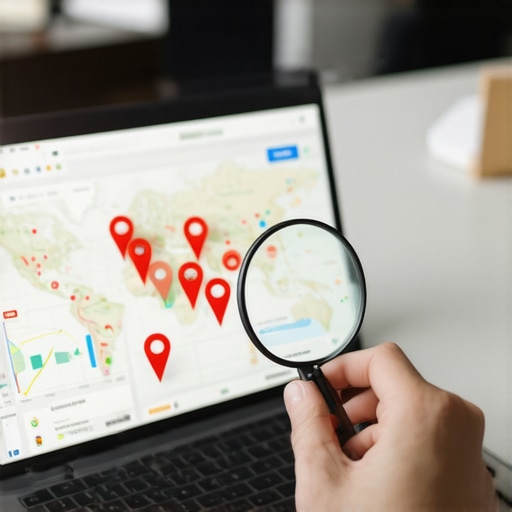
I stood on the sidewalk, the smell of wet concrete rising as a light rain hit the pavement. My client’s shop was right there; I could see the sign, but Google could not. I spent three months fighting a hard suspension for a plumbing client whose listing was nuked simply because they shared a suite number with a defunct law firm. Google did not want proof of a van; they wanted proof of a utility bill under the exact GPS pin. They saw a ghost in the machine. When your business vanishes from the local map, it is rarely a coincidence. It is often a microscopic error in the data layer that triggers a massive algorithmic rejection. You are not just fighting a search engine; you are fighting a spatial database that values precision over existence.
The ghost in the GPS coordinates
Map visibility drops are often caused by GPS coordinate shifts or address verification failures within the Google Business Profile database. If your latitude and longitude points overlap with a suspended business or a high-risk category, your local rankings will plummet instantly to protect the integrity of the map.
The algorithm calculates the distance between the user’s device and the latitude and longitude point assigned to your business. This is not just a straight line; it involves the density of the surrounding Points of Interest. When three businesses in the same category are within 500 feet, Google applies a filter. One business stays, the others disappear. This is the centroid collapse. I have seen companies spend thousands to buy local seo tools for gmb, only to realize their pin was dropped in the middle of a highway. Precision is the currency of the map pack. If you are struggling, you should look at why google map rankings drop suddenly and how to diagnose the cause to find the technical root.
“Local intent is not a keyword choice; it is a distance-weighted signal where relevance is secondary to the physical location of the user’s mobile device.” – Map Search Fundamental
Why your physical address is a liability
Mismatched business addresses and inconsistent NAP data act as negative ranking signals that confuse Google’s crawler. When your street address differs across local directories, the Map Pack algorithm loses trust in your physical location, resulting in a hard suspension or a ranking drop.
I once audited a locksmith who had four different variations of “Suite B” across the web. To a human, it is obvious. To a bot, it looks like four different businesses competing for one spot. This is why the address mismatch error killing your local phone calls is so dangerous. You need services to fix mismatched business address and phone number issues before you try to rank. The system is designed to favor the most stable data. If your footprint is messy, your visibility will be erratic. You might even need services to fix brand confusion from merged gmb listings if you have moved locations recently.
The three mile radius that determines your revenue
Proximity signals are the most powerful ranking factors in the Google 3-Pack, as the Vicinity algorithm prioritizes businesses physically closest to the searcher’s location. A service area business must define its geographic polygons carefully to avoid spam filters and proximity-based drops in local search results.
The math of proximity is unforgiving. Every millimeter of movement on the map changes your ranking probability. We use a step by step gmb ranking toolkit for beginners to map out where these invisible boundaries sit. If you are a plumber, your 3-mile radius is your lifeblood. If a competitor uses a keyword-stuffed name, they might steal that radius for a week, but they will eventually get caught. You should focus on 7 signals that actually move the needle for local map rankings rather than chasing fake proximity. Often, a local seo service to fix gmb hard suspension for service area business is the only way to recover when the algorithm decides your service area is too large.
Local Authority Reading List
- Mastering Google Pack Appearance
- Expert Tips for Map Ranking
- The Exact Reinstatement Steps
- The Profile Description Myth
Forensic traces of service area polygons
Service Area Businesses often suffer from profile invisibility because their service area polygons overlap with competitor territories or violate Google’s proximity thresholds. To recover map rankings, you must audit your service areas and ensure your verified address is not flagged for spam by the local algorithm.
When you hide your address, you are telling Google you do not have a storefront. This moves you into a different tier of the algorithm. If you have why your service area isnt showing up for local searches, it is likely because your verification data is weak. We often see seo services to fix mixed listings for multi location businesses trying to use the same phone number for ten different towns. This is a massive red flag. Google wants to see unique, local signals for every pin. If you are stuck, use 5 local seo tools that find hidden ranking gaps to see where your competitors are hiding their data. You might also need services to fix soft 404 and duplicate content issues on your landing pages to prove you are relevant to the neighborhood.
The behavioral weight of local sentiment
Local review sentiment and user interaction signals are processed by Natural Language Processing to determine the trustworthiness of a business. If your review velocity drops or you face a negative SEO attack, Google will demote your listing in the Map Pack to protect users from unreliable merchants.
I have seen competitors use VPNs to drop twenty 1-star reviews in an hour. It is brutal. You need services to recover from negative seo attack immediately when this happens. Google’s AI looks for patterns. If all your reviews come from the same IP range, they will be filtered. If they are legitimate but you are not responding, you are losing points. Stop writing generic review responses and start using keywords naturally in your replies. This shows the algorithm that you are an active, real business. If you are an agency, you should invest in google business profile seo tools for agencies to monitor these sentiment shifts in real time.
“Proximity is a probabilistic model; the radius of visibility expands when competition is low and contracts when the map is saturated with verified entities.” – Location Intelligence Whitepaper
Bypassing the centroid collapse
Centroid collapse occurs when Google filters out businesses that are physically located too close to a higher-authority competitor in the same business category. To bypass this filter, you must differentiate your primary category and use specific local schema edits to prove your unique business entity exists.
If you are in a skyscraper with fifty other lawyers, you are in trouble. The algorithm will often pick the one with the most authority and hide the rest. This is why why your law firm stays invisible in local search while others thrive. You need to use specific local schema edits to bypass larger competitors. It is not about being the biggest; it is about being the most verified. Use services to monitor and prevent future gmb suspensions so you do not lose your spot the moment a competitor reports you. The map is a battlefield, and your data is your armor. Keep it clean, keep it local, and never trust a cheap citation blast.