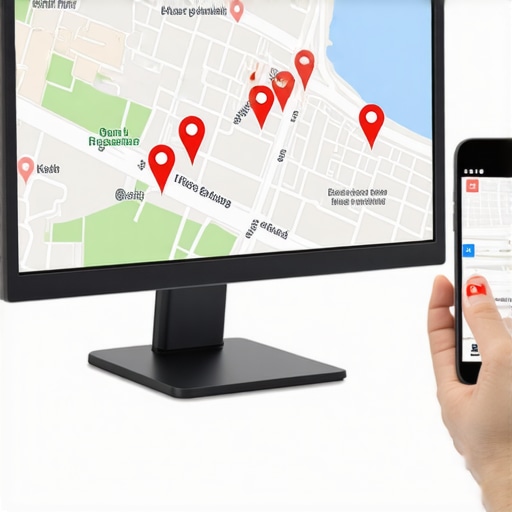
The smell of wet concrete always reminds me of the day the maps broke. I was standing on a street corner, camera in hand, watching a local roofer realize his business had vanished from the digital world. Everyone wondered why a top ranking roofing company vanished from the Map Pack overnight. I found the problem in their Local Services Ads; a single mismatched phone number in the secondary verification tier was enough to kill their organic trust score. This was not a glitch in the software; it was a fundamental collapse of the centroid. The roofer held a tablet showing he was number one, but on my phone, standing five feet away, he was nowhere to be found. The screen was lying to him. Most gmb ranking toolkit for small business owners rely on server-side requests that fail to mimic the messy, grainy reality of a real person walking down a sidewalk. This disconnect is where your revenue dies. If you want to understand why your dashboard looks like a win while your phone stays silent, you have to look at the raw data under the surface.
The ghost in the GPS coordinates
A software ranking tracker fails to match the actual map pack because it cannot replicate the hyper-local GPS signals and device-level personalization of a real user. These tools use static IP addresses and center-of-town coordinates that ignore the proximity weight of a mobile device moving through a specific neighborhood. The mathematical reality of local search is that a single city block can change your ranking from first to fifteenth. This is often why your ranking software shows a win when your phone isnt ringing. Google does not see a city as a single entity; it sees a grid of millions of coordinate points. A tracker might ping the map from a data center in Virginia while your customer is sitting in a coffee shop two miles from your storefront. That distance creates a massive signal gap. The physics of the vicinity update changed the game. Proximity is now the primary filter. When your tracker mocks a location, it lacks the behavioral history of a real Google account. It lacks the sensor data from an accelerometer. It lacks the Wi-Fi triangulation that a smartphone uses to pin a person’s exact location within three feet. This is why automated ranking tools often lie about your true local position and why you need to verify data manually.
“Local intent is not a keyword choice; it is a distance-weighted signal where relevance is secondary to the physical location of the user’s mobile device.” – Map Search Fundamental
Why your physical address is a liability
Your physical address becomes a ranking liability when Google detects inconsistencies between your reported location and the real-world signals of your service area. This happens most often with virtual offices, coworking spaces, or hidden addresses that do not match the GPS traces of your service vehicles. If you are looking for seo services to recover impressions after hiding business address, you are fighting a trust battle against a machine that values physical evidence over digital claims. I have seen businesses get buried simply because their map pin was ten feet off the actual building entrance. Google tracks where people actually stop and park. If the data says your business is in a suite but the heat maps show customers never enter that building, your authority drops. This is why your virtual office address is a red flag for the map pack. The algorithm is looking for the grainy, candid truth of a physical storefront. It wants to see the sidewalk, the signage, and the flow of traffic. When you use local seo services to normalize rankings after keyword stuffed business name edit, you are essentially cleaning up the digital graffiti that makes your listing look like spam. The machine is becoming a street photographer; it notices the glitches in the facade.
Local Authority Reading List
- Expert tips for ranking in 2025
- How to recover a suspended profile
- The audit toolkit we use every morning
- Why your profile stopped showing up
The three mile radius that determines your revenue
The three mile radius around your business is the only geographic area where your ranking software is even remotely accurate for high-competition keywords. Outside of this micro-zone, the map pack shifts based on the density of competitors and the movement patterns of searchers in neighboring zip codes. You might think you are dominant across the whole county, but the reality is much more fragmented. This is the recovery plan for businesses suffering from proximity based drops. You have to stop chasing a global win and start winning block by block. Software trackers often use a single point of entry to check your rank. They miss the nuance of the neighborhood boundaries. A real gmb audit and ranking toolkit should show you a grid of results, not a single number. If you are using the software tool we use to audit local map visibility across 50 miles, you will see that your rank looks like a weather map. It is green near your office and turns red as you move away. There is no such thing as a single rank in local SEO. There are only thousands of individual proximity results. This is why your rank tracker is showing ghost positions that dont exist. It is taking the best possible result from the easiest coordinate and presenting it as the universal truth.
The forensic trace of a service area polygon
A service area polygon is a mathematical boundary that tells Google exactly where your business operates without a physical storefront. If this polygon is set incorrectly, or if it overlaps too heavily with competitors using fake addresses, your visibility will vanish into the filter. This is a common cause for needing local seo services to fix gmb hard suspension for service area business. Google is comparing your service area to the actual locations of your reviews. If you say you serve the whole state but all your customers are within ten miles of your house, the algorithm sees the lie. It looks for the signal in the noise. I often suggest google business profile recovery services when a business gets greedy with their service area. The algorithm prefers a small, honest area over a large, theoretical one. Image metadata is a huge part of this forensic trace. When customers upload photos taken at their homes, Google reads the GPS tags in those files. These photos provide more ranking power than a thousand words of text. They are the candid evidence of your local existence. If you are experiencing an emergency seo services for sudden ranking drop, check your latest reviews for location-tagged photos. They might be the only thing keeping your listing alive.
“Local justification triggers are the bridge between what you say you do and what the customer actually experiences at the Point of Sale.” – Map Search Fundamental
[image placeholder]
The local justification triggers
Local justifications are the small snippets of text that appear under your map listing to explain why you were chosen for a specific search. These triggers come from your website content, your reviews, and even the captions on your photos. If your top google business profile seo toolkits are not tracking these justifications, they are missing the reason you are winning or losing. A tracker will tell you that you are in position three. It won’t tell you that you are there because a review from three years ago mentioned a specific spare part. This is how to use tools to rank your google business profile effectively. You look for the justifications. You see what the algorithm is highlighting. If it shows “Their website mentions emergency repair,” then you know your content is working. If it shows nothing, your profile is a blank wall. You need to provide the algorithm with more raw material. This is where the simple content shift that gets local visitors to pick up the phone comes into play. Stop writing for the machine and start writing for the person on the street corner who needs a solution right now. The machine will follow the person. It always does.
The danger of automated ranking tools
Automated tools often miss the biggest ranking errors because they are designed to give you a pretty report rather than the ugly truth of your digital footprint. They ignore the quiet citation errors making your business look untrustworthy to Google. They skip over the mismatched phone numbers on old directory listings that act like a slow leak in your authority. I have seen businesses spend thousands on local seo services only to have their rankings tank because of a single character error in their address. This is the danger of using automated tools to fix your business information. They lack the human eye to see the glitch. They cannot tell the difference between a real shop and a lead-gen trap. When you do a gmb vs local listing tools comparison, you have to ask which one gives you the most granular data. Which one shows you the actual photos being used by your competitors? Which one identifies how to fix the suggest an edit trolls targeting your business? The tools that matter are the ones that let you see the map the way a customer sees it. Grainy. Real. Unfiltered. If your tracker shows you a perfect score, it is likely lying. The real map is never perfect.