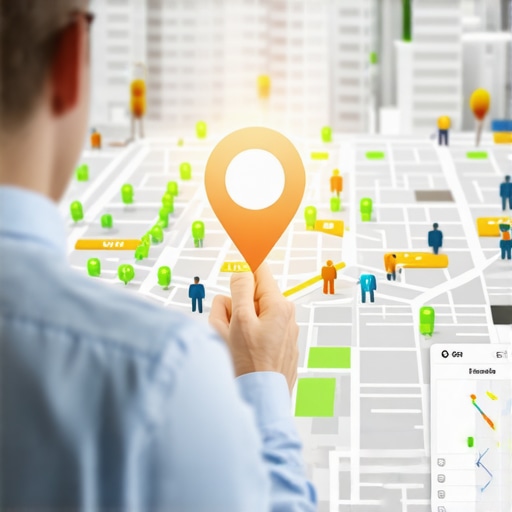
Why Your Map Tracker Shows You at the Top While Customers Can’t Find You
There is a specific kind of frustration reserved for the local business owner who opens their dashboard to see a sea of green circles. Your google maps rank tracker tells you that you are sitting comfortably at #1 for your most valuable keywords. You feel a sense of accomplishment – until you look at your call logs. The phones aren’t ringing. The “Request a Quote” forms are empty. You pull out your own phone, drive three blocks away, search for your service, and you are nowhere to be found. This is the “Ghost Ranking” phenomenon, a widening gap between automated reporting and real-world visibility.
As a Local SEO Consultant, I’ve audited thousands of profiles. A recent comprehensive audit of 76,228 local businesses found that a staggering 66% are missing basic local SEO fundamentals despite “ranking” for specific terms in their tracking software. This discrepancy isn’t just a technical glitch; it’s a fundamental misunderstanding of how Google’s local algorithm has evolved. If you’ve ever wondered Why Your Rank Tracker Is Showing Ghost Positions That Don’t Exist, you need to understand that a single data point in a report rarely reflects the chaotic, proximity-based reality of a mobile searcher.
The Rank Tracker Illusion: Point-in-Time vs. Real-World Proximity
To understand why your reports are lying to you, we have to look under the hood of how most local seo tools actually function. A standard google maps rank tracker operates by sending a request to Google’s API from a specific set of GPS coordinates – latitude and longitude. If that tracker is configured to ping Google from your office’s front desk, of course, you are going to appear as #1. You are the most relevant and proximal result to yourself.
However, Google’s local search algorithm is hyper-sensitive to the searcher’s physical location. This is known as the “Proximity Signal.” If a potential customer is standing just two miles away, the “Proximity” signal for your business weakens significantly. While your tracker might be reporting a static “average” rank, the reality is a shifting mosaic. In high-competition niches like personal injury law or emergency plumbing, your ranking can drop from #1 to #10 simply by crossing a major intersection.
The illusion is further complicated by the way trackers handle IP addresses and data centers. Many cheap tracking services use proxy servers that don’t accurately mimic the behavior of a mobile device on a cellular network. When a real human searches on 5G while moving in a vehicle, Google uses a combination of GPS, Wi-Fi triangulation, and cell tower data to pinpoint them. Most trackers cannot replicate this level of granularity, leading to “clean” reports that don’t match the “messy” reality of consumer behavior. To get an accurate picture, you need google maps seo tools that utilize a multi-point geo-grid, rather than a single-point check.
The Three Pillars of Local SEO: Proximity, Relevance, and Prominence
To bridge the gap between your tracker and your customers, you must master the three pillars that Google uses to determine the “Local 3-Pack.” If you want to Unlock the Power of the Business 3 Pack, you have to balance these often-competing factors.
1. Proximity
Proximity is often the “silent killer” of local rankings. No matter how well-optimized your profile is, Google prioritizes the searcher’s physical location over almost everything else. This is especially true for “near me” queries. Research shows there is a “Proximity Wall” at roughly 5 to 7 miles for most service industries. Once a searcher passes that threshold, your business effectively disappears from the Map Pack, regardless of how many 5-star reviews you have. Your google maps rank tracker might show you ranking city-wide, but if you aren’t accounting for the Proximity Wall, you are chasing ghosts.
2. Relevance
Relevance is how well your google business profile seo matches the intent of the searcher. This involves your primary and secondary categories, the services you list, and the keywords found in your business description and website. If a customer searches for “emergency water heater repair” and your profile only mentions “plumbing,” you lose relevance. This is where google business profile optimization becomes critical. You must ensure that your digital footprint mirrors the specific language your customers use when they are in a high-intent buying phase.
3. Prominence
Prominence refers to your business’s “authority” both online and offline. This is determined by your review count, your average rating, the quality of your backlinks, and your mentions across the web (citations). Prominence is the only factor that can occasionally “break” the Proximity Wall. A world-renowned restaurant or a highly-rated law firm with thousands of reviews may show up for a searcher 10 miles away, whereas a mediocre business would be filtered out at 2 miles. Building prominence is a long-term play that requires a robust google maps ranking service strategy.
The “After Hours” Disappearing Act
One of the most overlooked reasons for the discrepancy between reports and reality is the “Open Now” filter. Google’s algorithm is designed to provide the best user experience, which often means filtering out closed businesses for “near me” or “emergency” searches. If you are a plumber, an HVAC technician, or a locksmith, your rankings likely drop the moment your office hours end in your dashboard.
Imagine your google maps rank tracker runs its daily check at 10:00 AM. You look at the report at noon and see yourself at #1. However, your customer has a pipe burst at 6:00 PM. If your business hours are set to close at 5:00 PM, Google may hide your profile in favor of a competitor who is listed as “Open 24 Hours.” This creates a situation where you are invisible during the hours when your customers need you most. This is a primary reason Why Your Map Ranking Flatlines Even After Optimizing Every Basic Signal. You aren’t just competing against other businesses; you are competing against the clock and Google’s desire to provide immediate, actionable solutions to its users.
To combat this, businesses must be strategic about their listed hours and consider implementing features like Google Messages or a 24/7 answering service that allows them to remain relevant in the eyes of the algorithm even when the physical doors are locked.
Service Area Business (SAB) Pitfalls: The 20-Mile Myth
For Service Area Businesses (SABs) like roofers, landscapers, and house cleaners, there is a common misconception that selecting “Service Areas” in the Google Business Profile dashboard will help you rank in those areas. Let me be clear: selecting a town 20 miles away in your settings does NOT help you rank there. It only tells Google where you are willing to drive; it provides zero ranking signal.
To rank google business profile in a neighboring town, you need local signals – not just a dashboard setting. Google looks for “geo-relevance.” This means having landing pages on your website dedicated to those specific cities, mentioning local landmarks, and gathering reviews from customers located in those areas. Many SABs fall into the trap of setting a massive 50-mile radius in their settings and then wondering Why Your Service Area Pages Fail to Reach the Next Town Over. Without localized content and proximity-based signals, the algorithm will always default to the business that has a physical verified address closer to the searcher.
Effective google business profile seo for SABs requires a sophisticated approach to building “digital proximity.” This includes local link building and ensuring your NAP (Name, Address, Phone Number) consistency across the web reinforces your connection to the specific regions you serve.
2026 Algorithm Updates: LiDAR, AR, and IoT Signals
As we move into 2026, the local search landscape is shifting from “stated data” to “verified real-world data.” Google is increasingly leveraging advanced technologies to verify the physical presence and activity level of a business. We are now seeing the impact of what many in the industry call the “2026 LiDAR Patch.”
Google is using LiDAR data from its Street View cars and even user devices to create 3D maps of business fronts. They are checking to see if your signage matches your profile and if your storefront is actually accessible to the public. Furthermore, the integration of IoT (Internet of Things) signals allows Google to track store foot traffic in real-time. If your google maps rank tracker says you are #1, but Google’s IoT data shows that no one has physically entered your store in three days, your ranking will eventually plummet. Google wants to send users to “thriving” businesses, not ghost storefronts.
Additionally, Augmented Reality (AR) data from users utilizing “Live View” in Google Maps provides Google with massive amounts of visual confirmation. If you want to stay ahead, you need google maps seo tools that account for these real-world signals. Understanding Why Your Local Business Ranking Dropped in the 2026 LiDAR Patch is essential for any business relying on physical foot traffic. The algorithm is no longer just reading text; it is “seeing” your business.
How to Audit Your “Real” Visibility
If you suspect your reports are misleading you, it’s time to perform a manual audit of your real visibility. Stop looking at a single number on a spreadsheet. Instead, you should use a google business profile audit tool that provides a geo-grid heatmap. This shows you exactly where your rankings “fall off a cliff.”
- Analyze the Heatmap: Look for patterns. Do you rank well to the North but fail to the South? This could indicate a competitor’s stronghold or a geographic barrier like a river or highway that Google’s algorithm perceives as a boundary.
- Test Different Times: Perform searches during business hours and after hours. This will reveal if your “Open Now” status is a major ranking factor for your specific niche.
- Check Mobile vs. Desktop: Local search behavior is dominated by mobile. Ensure your google maps rank tracker is specifically simulating mobile search environments.
- Audit Your Metadata: Many businesses fail because they haven’t addressed The Specific Data Points Your Current GMB Audit Tools Are Overlooking, such as photo metadata or the “Attributes” section of the GBP dashboard.
By using a comprehensive google maps optimization strategy, you can identify the “blind spots” in your current reporting and take corrective action before your competitors do.
Conclusion: Moving Beyond the Dashboard
At the end of the day, a google maps rank tracker is just a tool – it is not the goal. Ranking is simply a means to an end: generating leads, sales, and growth for your business. If your dashboard is green but your phone is silent, the tracker is wrong, and your strategy needs an immediate pivot. Real-world visibility is a combination of proximity, relevance, prominence, and increasingly, real-world verification through LiDAR and IoT data.
Don’t let “Ghost Rankings” lull you into a false sense of security. Perform a manual search from a different zip code, or better yet, use SEO Viper Tools to get a true, data-backed google maps optimization report. It’s time to move beyond the dashboard and start reaching the customers who are actually looking for you.